
Negative space in photography: why less makes photos stronger
Empty areas in a photograph are not wasted space. Used deliberately, sky, water, fog and plain walls give a subject emphasis, scale and mood that a crowded frame never can.
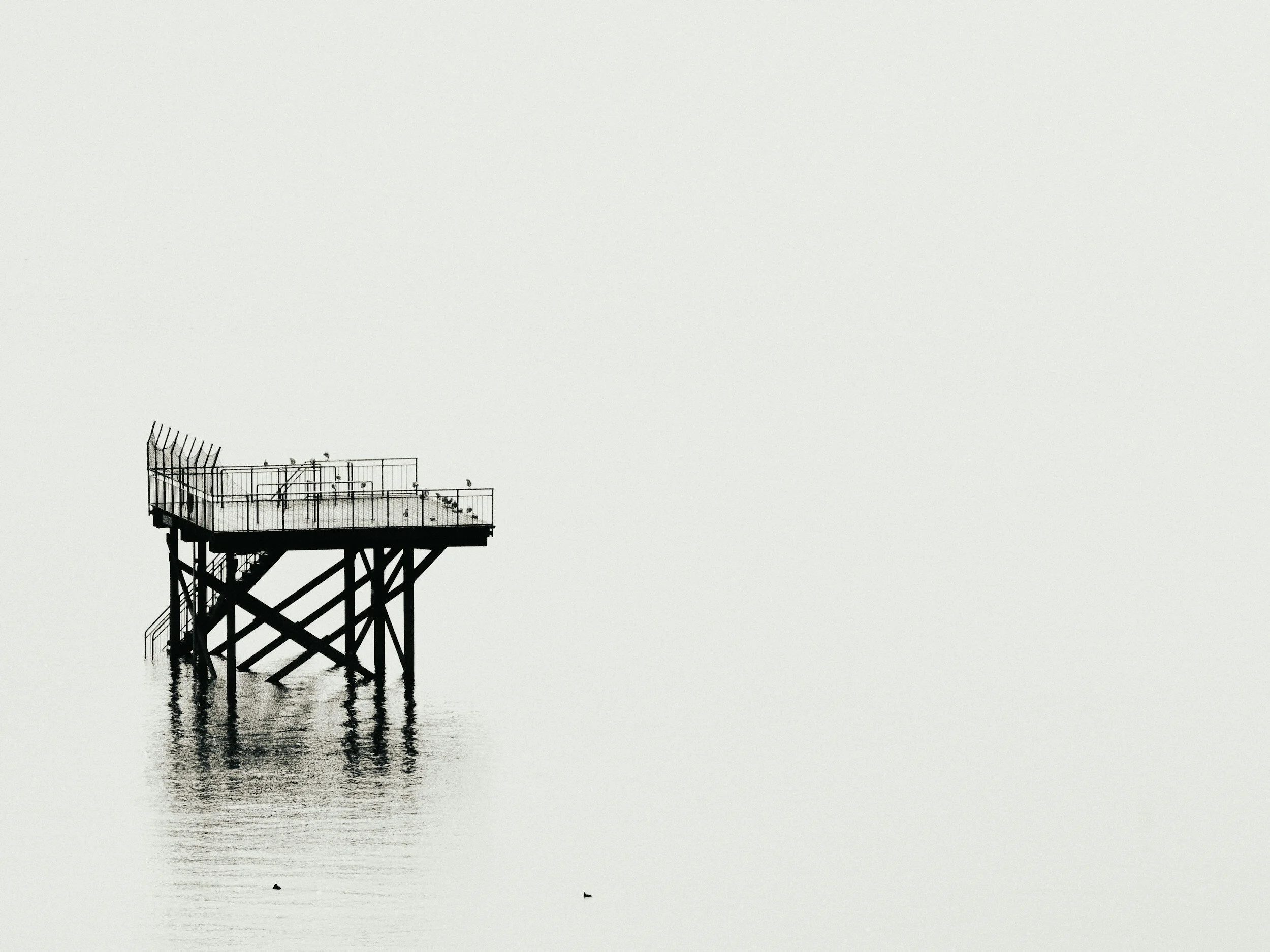
A single fisherman stands at the end of a jetty on a still winter morning. Fog has erased the far shore of Port Phillip Bay, so the water and sky merge into one pale grey sheet. The figure takes up perhaps a fortieth of the frame. Everything else is empty. And yet the eye goes straight to him, and stays there, because there is nothing else to look at.
That emptiness is negative space, and it is one of the most useful and least used tools in photography. Most beginners fill the frame because empty areas feel wasted. Used deliberately, they are the opposite: they give the subject room to matter.
What is negative space in photography?
Negative space is the area around and between the subject of a photograph. The subject itself is the positive space. Negative space is usually simple and uniform: open sky, still water, fog, sand, snow, a plain wall, a dark shadow. It does not have to be white, or blank, or even literally empty. A wall with a fine texture or a sky with soft gradation still counts, provided it is quiet enough not to compete with the subject.
The key word is quiet. Empty space and negative space are not quite the same thing. A frame with a small subject lost among clutter, or with a large area of bland but distracting detail, has space but no clear purpose. Negative space works when it is simple, and when the subject stands out strongly against it, through contrast in tone, colour or shape.

Why negative space makes photos stronger
It creates emphasis. When there is one thing in a frame, the viewer knows immediately where to look. Negative space removes the competition.
It creates scale. A small figure surrounded by space looks small, and the landscape around it looks vast. This is why a lone surfer on a wide beach or a single walker on the salt at Lake Tyrrell can say more about size than any wide-angle view packed with detail.
It creates mood. Large areas of empty space tend to feel calm, lonely, contemplative or cold, depending on colour and light. A pale sky suggests openness and quiet; a large dark area suggests weight and mystery. The same subject framed tightly and framed with space can tell two very different stories.
It balances the frame. A small, strong subject has more visual weight than its size suggests, especially if it is dark against light or bright against dark. Place it off-centre and the space on the other side becomes its counterweight.
Negative space removes the competition.
There is also a practical benefit. Photographs with generous negative space are useful for design work: book covers, posters, magazine layouts and web banners all need clean areas for text. Many stock and editorial buyers look for exactly this.
How to use negative space: placement and proportion
Start with a strong, simple subject. Silhouettes, clear shapes and single objects work best: a tree, a person, a boat, a lamp post, a bird. If you cannot describe the subject in one or two words, the image is probably too busy for negative space to help.
Then decide where to place it. Near a third line or towards a corner usually works better than dead centre, because it creates tension between the subject and the space. If the subject has a direction, such as a face, a walking figure or a boat under sail, give the space to the side it faces or moves towards. A figure walking out of a frame edge, with all the space behind it, feels like it is leaving; the same figure walking into the space feels like it is going somewhere.
Proportion is a matter of taste, but be bold. Negative space that fills half the frame often looks accidental. Space that fills three-quarters, or nine-tenths, looks intentional. Try the same scene with the subject large, medium and very small, and compare.
Your aspect ratio is part of the composition too. A tall vertical frame with a small figure at the bottom emphasises height and sky. A wide panoramic crop emphasises horizontal space, such as a long horizon or empty beach.
Where to find negative space in Melbourne
Water and sky are the easiest starting points. Princes Pier at sunset, with the old piles marching into the flat water of the bay, offers endless variations; our Princes Pier sunset workshop works on exactly this kind of composition. Calm mornings along the beaches of Port Phillip Bay, from Williamstown to Brighton and down the Mornington Peninsula, produce smooth water that merges with the sky.
Architecture provides clean walls and geometric planes. The glass and concrete of Docklands and the pale forecourts around Southbank have large, uniform surfaces where a single passer-by or bird can become the whole subject. Shoot upwards and plain sky becomes negative space behind the edges of buildings.
Fog is the gift of Melbourne's cooler months. Mount Macedon and the Dandenong Ranges on a foggy morning erase busy forest backgrounds, leaving individual trees standing out in soft grey. Further afield, Lake Tyrrell's salt crust and the dunes along the coast offer vast, simple surfaces.

Negative space mistakes to avoid
The most common error is grey sky. Cameras try to render large bright areas as mid-grey, so a white, overcast sky or a snowfield comes out dull. Add positive exposure compensation and check the histogram, keeping the highlights just short of clipping.
The second is distractions in the empty area. A single contrail, a distant bird, a dust spot or a small bright patch becomes enormously noticeable when there is nothing else in the space. Look carefully at every part of the frame before you press the shutter, and clean up the rest in editing with the healing tool.
The third is a weak subject. If the subject lacks contrast against the space, it disappears. A dark figure against pale fog works; a mid-grey figure against mid-grey fog does not. Move until the shape is clean and separate.
Finally, do not let the idea become a formula. Negative space is one way to make a subject stand out. Some scenes need detail, texture and complexity. The skill is recognising which is which. For more on building simple, confident compositions, try the long exposure seascape workshop, where smoothed water turns busy seas into clean space.
Practise this
- Photograph one subject three times: filling the frame, filling a quarter of it, and filling a tiny fraction. Decide which tells the strongest story.
- On an overcast day, photograph a single tree or post against the sky at 0, +1 and +2 EV compensation. Compare how clean the sky looks.
- Find a plain wall in the city and wait for a single person to walk past. Place them near one edge, walking into the space.
Questions, answered.
What is negative space in photography?
Why is negative space important in photography?
How much negative space should a photo have?
Why does my white sky look grey?
Published by CapturEDU, Melbourne photography education. Our educators are award-winning photographers with a Master of Arts in Photography (RMIT), AIPP and RPS membership.

