
How to choose a photography workshop worth your money
Group size, time behind the camera and feedback on your own photographs matter more than the price or the label. A fair guide to choosing a photography class that will actually make you better.
Picture a sunset workshop on a Melbourne pier. Fifteen people arrive with tripods. The first hour is spent indoors on slides about the exposure triangle. By the time the group walks out, the sun has set, the tutor is helping one person with a menu setting, and fourteen others are guessing. Everyone goes home with photographs. Few go home with a skill, or any idea what they did wrong.
Nobody in that scene did anything dishonest. The workshop simply was not designed around the thing people pay for: making photographs, with someone beside them who can explain what just happened. Knowing how to spot that difference before you book is worth more than any single class.
Is a photography course worth it?
It can be, and the reason is feedback. Books, videos and forums will teach you what aperture does. They cannot look at your photograph, see that the focus point landed on the fence rather than the face, and show you the button that fixes it. Good tuition compresses months of trial and error into an afternoon, because someone is catching the mistakes you do not know you are making.
It is less worth it when the class repeats what free material already covers, when you are one of too many people to get individual attention, or when the level is wrong for you. Most disappointing workshops fail on one of those three counts. The rest of this guide is about checking them in advance.
Group size, shooting time and feedback
Start with the numbers. Divide the time on location by the number of participants, and you have a rough ceiling on the individual attention you will get. A three-hour class with 15 people cannot give each person more than a few minutes. With six to eight people, the educator can reach everyone several times, which is when learning actually happens.
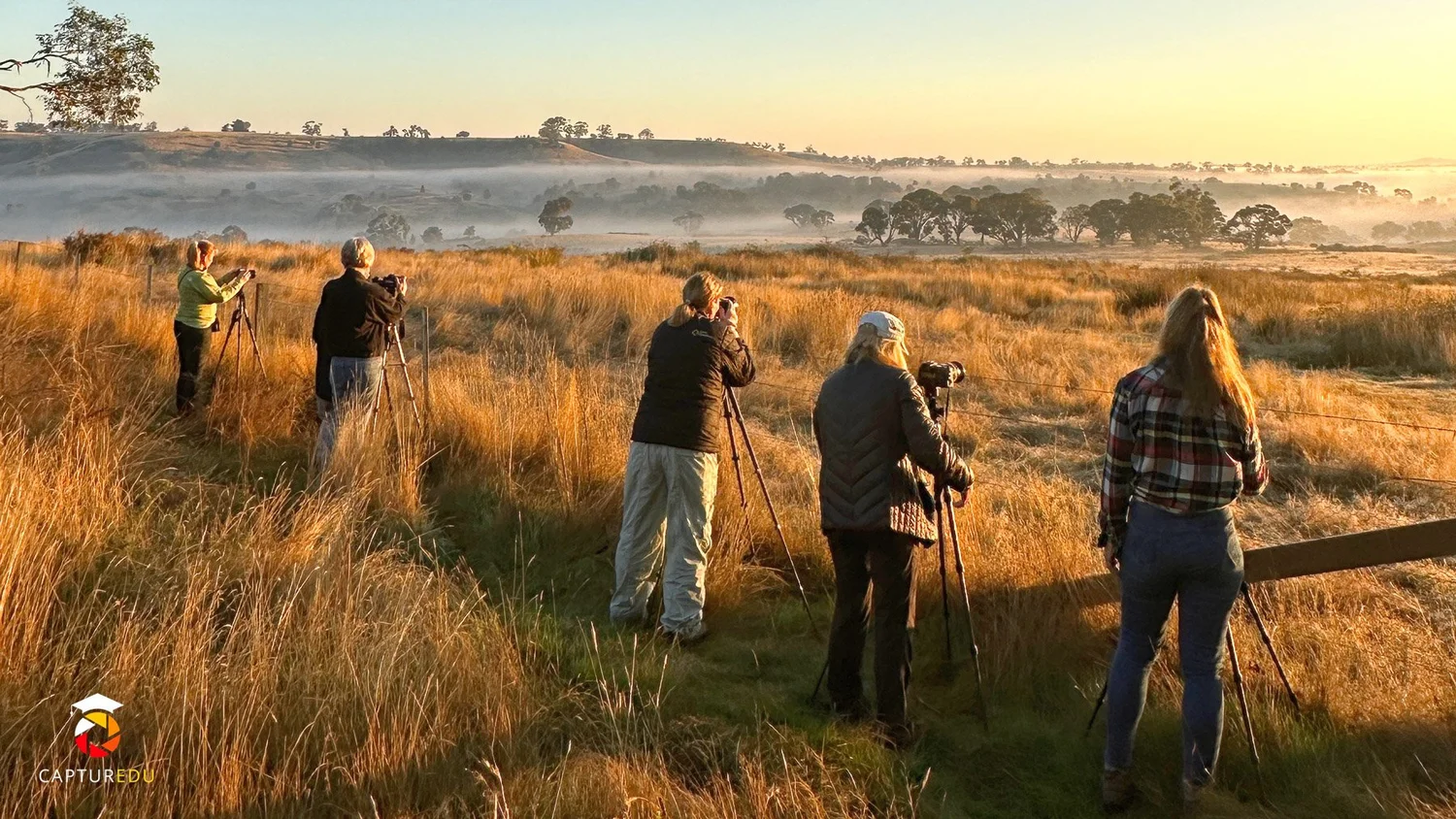
Then ask how the time is split. A good practical workshop keeps explanation short and puts most of the session into shooting. Look for a schedule, or ask for one. If the listing says three hours but an hour is a presentation in a café, you are buying a two-hour workshop.
Most important of all: will someone review your own photographs? Not a slideshow of the educator's portfolio, but your frames, on your camera, during or after the session, with specific comments on what to change. This is the single best predictor of whether you will improve.
Good tuition compresses months of trial and error into an afternoon, because someone is catching the mistakes you do not know you are making.
Checking the educator's credentials
Photography is unregulated, and anyone can run a class. That is not a problem in itself, but it means you should look for evidence. Is the educator still working as a photographer, with recent, published work you can see? Do they belong to a professional body, or hold relevant qualifications? Have they taught for a while, and is teaching a serious part of what they do rather than a sideline?
Look at their photographs with a critical eye, and ask whether you would be happy to make work like that. Then look for evidence they can teach, which is a separate skill. Someone who makes superb images but cannot explain their decisions is an inspiring guide but a frustrating teacher.
Photography classes for beginners: levels, location and light
Level labels are inconsistent across the industry. One provider's intermediate is another's beginner. Ignore the label and read what you are expected to know. If a long exposure class assumes you can already shoot in manual mode, and you cannot, you will spend it catching up. Good providers state the prerequisites plainly and will tell you honestly if a class is not right for you.
Location and timing matter more than people expect. A sunset workshop should be on location well before sunset and continue into blue hour. A street photography class should run when the city is busy. A class held in the middle of a bright day will teach you less about light than one scheduled around it. Check the start time against the sunset time for that date.

Then check the weather policy. Outdoor workshops are exposed to Melbourne's four-seasons-in-a-day habit. Will the session move, run in a modified form, or be rescheduled if conditions are unsafe? Rain is not always a reason to cancel, since overcast light and wet streets can be superb for photography, but lightning, high winds and unsafe coastal conditions are.
What's included, reviews, and online vs in person
Read the fine print on inclusions. Are entry fees, transport, parking or equipment hire extra? Is there any follow-up, such as notes, a reading list or a chance to send images for comment afterwards? None of these is essential, but they change the value.
Reviews are useful when they are specific. Five stars and the word great tell you little. A review that mentions a particular skill learned, or a problem the educator solved, tells you a lot. Look across several platforms if you can.
Online courses have a real place. They are affordable, you can pause and repeat them, and they suit theory and software such as Lightroom well. What they cannot do is stand beside you in the field while you change a setting. Many people get the best of both by learning concepts online and booking in-person sessions for the hands-on practice.
When a private lesson or mentoring is better
Group workshops are excellent value for learning a specific technique in company. They are less suited to some situations: if you have a specific camera problem, want to work on your own schedule, need to move faster or slower than a group, or want to build a body of work over months.

A private photography lesson is often the quicker route for camera set-up, Lightroom or a single skill. Mentoring suits people with a project or a portfolio in mind, because it adds continuity: someone who sees your work develop over time and can steer it.
For what it is worth, our own approach reflects the questions above. Our group workshops run for two to three hours, with no more than eight people, and follow the same pattern: explain, demonstrate, photograph, review. We would rather you booked the right class elsewhere than the wrong one with us.
Practise this
- Pick two workshops you are considering and divide the shooting time by the number of participants for each.
- Write down the one skill you most want to learn, then check which class promises to teach exactly that.
- Email one provider with the six questions from the cheat sheet, and judge them partly on how clearly they reply.
Questions, answered.
Is a photography course worth it for beginners?
How many people should be in a photography workshop?
Are online photography courses as good as in-person classes?
Should I take a group workshop or a private lesson?
Published by CapturEDU, Melbourne photography education. Our educators are award-winning photographers with a Master of Arts in Photography (RMIT), AIPP and RPS membership.
