
Golden hour vs blue hour: the best time of day for photos
The same pier can look like two different places forty minutes apart. Golden hour and blue hour are the reason, and neither keeps to the clock.
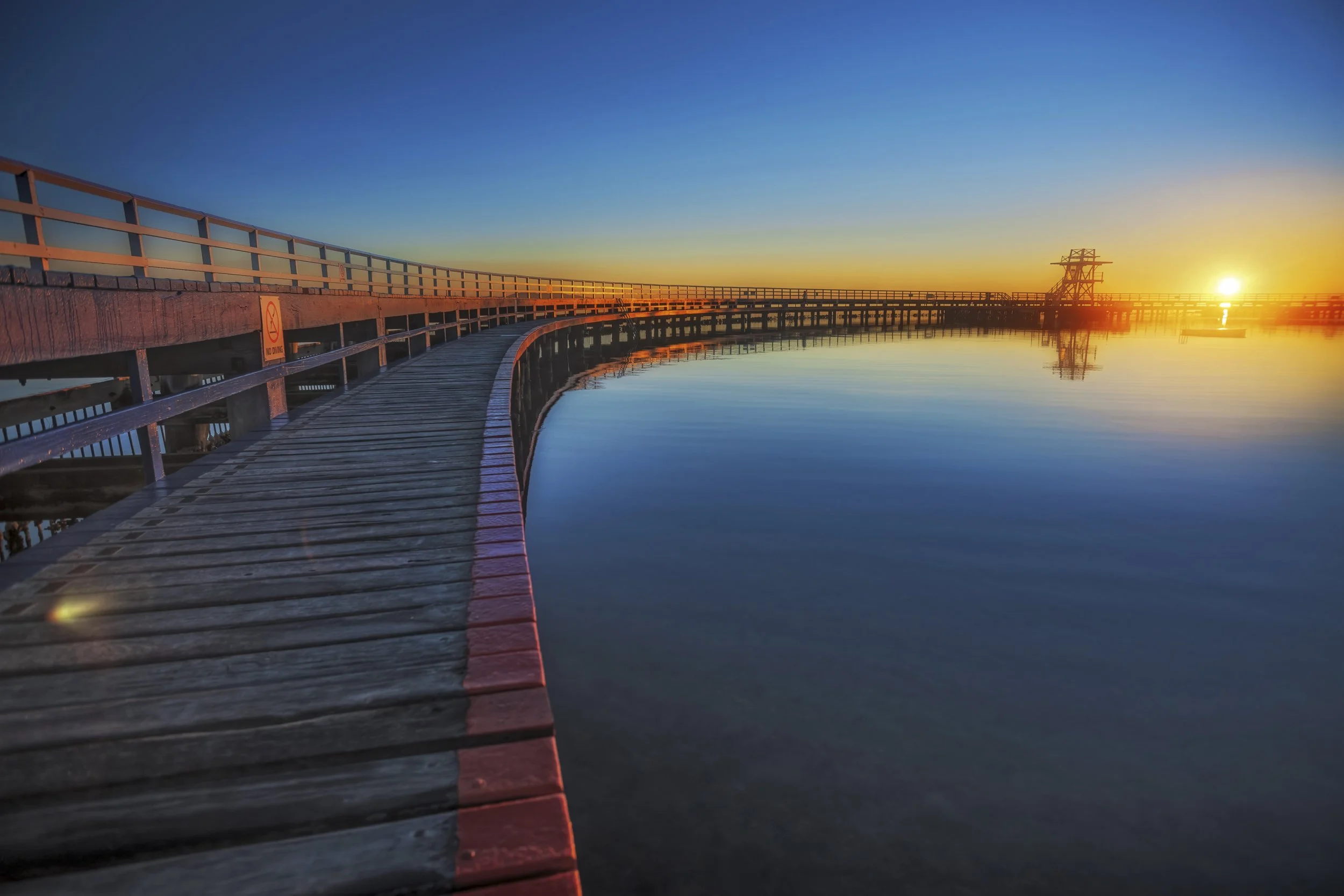
Stand at the end of a timber pier on the Bellarine Peninsula late on a still summer evening and the whole scene turns to honey. The sun sits a hand's width above the horizon. Every plank throws a long shadow towards you, the water carries a path of gold, and anything facing west glows as if lit from inside. Forty minutes later, from the same spot, the gold is gone. The water has gone silver-blue, the sky deepens by the minute, and the lights on the far shore begin to register.
Photographers call these two windows golden hour and blue hour. Neither is exactly an hour, neither keeps to the clock, and both are worth planning a day around.
What is golden hour?
Golden hour is the period when the sun is low in the sky, roughly from the horizon up to about six degrees above it. It happens after sunrise and before sunset. Because the sunlight passes through more atmosphere at that low angle, more of the blue is scattered away and the light that reaches you is warmer and softer.

What makes it useful is not just colour. It is direction. With the sun low, light comes from the side rather than from overhead. Textures such as sand ripples, tree bark and weathered timber show up in relief. Faces are lit evenly without dark eye sockets. Long shadows give flat ground a sense of depth.
Compare that with midday in a Melbourne summer, when the sun is high overhead. The light is hard, shadows fall straight down, and colours look flat. That is why so many landscape photographers pack up at 11 am and come back at 6 pm.
What is blue hour?
Blue hour is the period of twilight when the sun is below the horizon, commonly defined as roughly four to eight degrees below it. It comes after sunset and before sunrise. There is no direct sunlight, only light scattered through the upper atmosphere, and that light is dominated by blue.
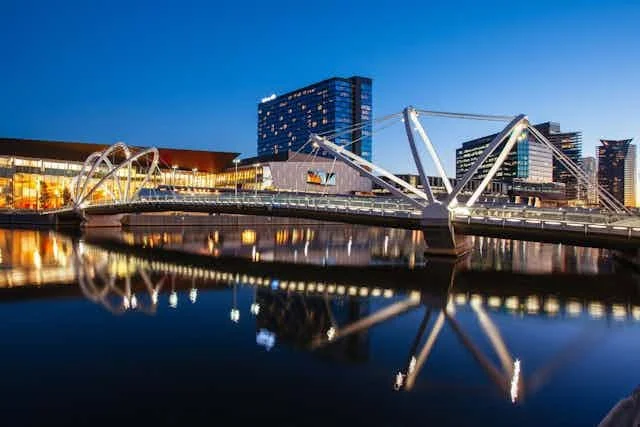
The light is soft, even and cool. There are no hard shadows. And it is dim enough that artificial lights, such as streetlights, office windows and the lights on a bridge, start to register at about the same brightness as the sky. That balance is the magic of blue hour. The sky still has colour and the buildings still have shape against it, but the city is already lit.
Later, once the sky goes fully dark, that balance breaks. Lights become hot points against black, and the frame loses its sense of place.
Golden hour vs blue hour: which is better for photos?
Neither. They suit different subjects.
| Golden hour | Blue hour | |
|---|---|---|
| Sun position | Just above the horizon | Just below the horizon |
| Colour | Warm gold and orange | Cool blue, often with pink or purple near the horizon |
| Shadows | Long and directional | Almost none |
| Best subjects | Portraits, landscapes, texture, backlit silhouettes | Cityscapes, bridges, water, lit buildings |
| Typical length in Melbourne | About 45 minutes to an hour | About 20 to 30 minutes |
| Tripod needed? | Usually not | Usually yes |
The best evenings give you both. Arrive an hour before sunset, shoot the warm light, keep shooting as the sun drops behind the horizon, and stay for twilight. Our Princes Pier sunset workshop is built around exactly that sequence.
Neither is exactly an hour, neither keeps to the clock, and both are worth planning a day around.
When is golden hour in Melbourne, summer and winter?
The timing moves a lot through the year, and so does the length.
In summer, the sun sets late. Around the start of January, sunset in Melbourne is at roughly 8.45 pm, so evening golden hour runs from about 7.45 pm and blue hour falls after 9 pm. Sunrise comes before 6 am, which makes morning light an early start.
In winter, sunset in late June is a little after 5 pm and sunrise around 7.30 am. That is the easiest season for photographers: good light before work and again on the way home. The sun also stays low all day in a Melbourne winter, reaching only about 29 degrees above the horizon at noon near the solstice, so the light is softer and more directional right through the afternoon.
Length changes too. At Melbourne's latitude, the sun sinks through the sky at a steeper angle around the March and September equinoxes, so golden hour and blue hour are at their shortest. Around the solstices, particularly in midsummer, the sun sets at a shallower angle and both windows stretch. Further from the equator, as in Tasmania or northern Europe, they last longer again; in the tropics, they are brief.
Because of all this, the reliable approach is to check the exact sunrise and sunset times for your location and date in a sun-position app or an online sunrise and sunset calculator. Many of those apps also show which direction the sun will set, which matters as much as the time.
Camera settings for golden hour and blue hour
For golden hour, the light is still bright enough to hand-hold. Keep ISO low and choose the aperture for the picture: f/8 to f/11 for a landscape, f/2.8 to f/4 for a portrait with a soft background. Set white balance to Daylight rather than Auto, because auto white balance often tries to correct the warm light you came for. If you are shooting towards the sun, the sky will be far brighter than the land; expose so the brightest parts keep detail, and lift the shadows later.
For blue hour, use a tripod. The light falls fast and a shutter of several seconds is normal. ISO 100 and f/8 is a good starting point, adjusting the shutter as the sky darkens. Expect to lengthen the exposure every few minutes. Daylight white balance keeps the blue; if the city lights look too orange, cool it slightly, to around 4500 K. Shoot RAW so you can fine-tune later. Docklands is one of the best places in Melbourne to practise, with bridges, towers and still harbour water all within a short walk, and it is where we run our Docklands blue hour workshop. Our guide to Melbourne photography locations lists more.
Practise this
- Pick one spot and photograph it at midday, at golden hour and at blue hour on the same day. Put the three frames side by side.
- Photograph a friend facing the low sun, then with the sun behind them. Compare how the light shapes the face each time.
- At blue hour, set up on a tripod and take one frame every three minutes from sunset until full dark. Find the frame where the sky and the city lights balance.
Questions, answered.
What time is golden hour?
How long does blue hour last?
Is golden hour better than blue hour?
Can you photograph golden hour on a cloudy day?
Published by CapturEDU, Melbourne photography education. Our educators are award-winning photographers with a Master of Arts in Photography (RMIT), AIPP and RPS membership.
